Automotive Data Center Solution
The Automotive Data Center is developed to handle new and existing use cases of the automotive industry include but not limited to Autonomous Driving (ADAS), Telemetry, Alert Systems, and new usage models that have not been yet developed to monetize data.
High level Use Cases
- ADAS
- Alert Emergency Vehicle
- De-register Car
- Dynamic Mapping
- In Vehicle Infomatics
- Manage Applications
- Manage Application Stack
- Manage Cloudlets
- Manage Data Coordination
- Manage Data Exchange
- Manage External Connections
- Manage Infrastructure
- Manage Policies
- Manage Security
- Manage Services
- Register Car
- Report Accident
- Switch Data Center
- Transmit Telemetry
Users
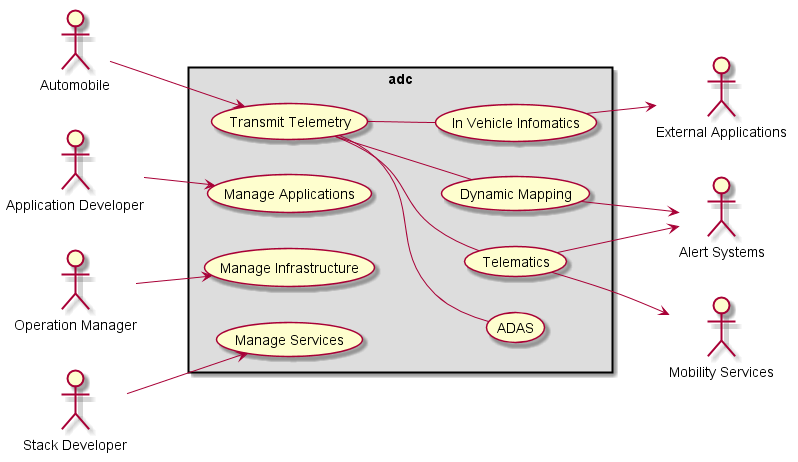
High Level Overview
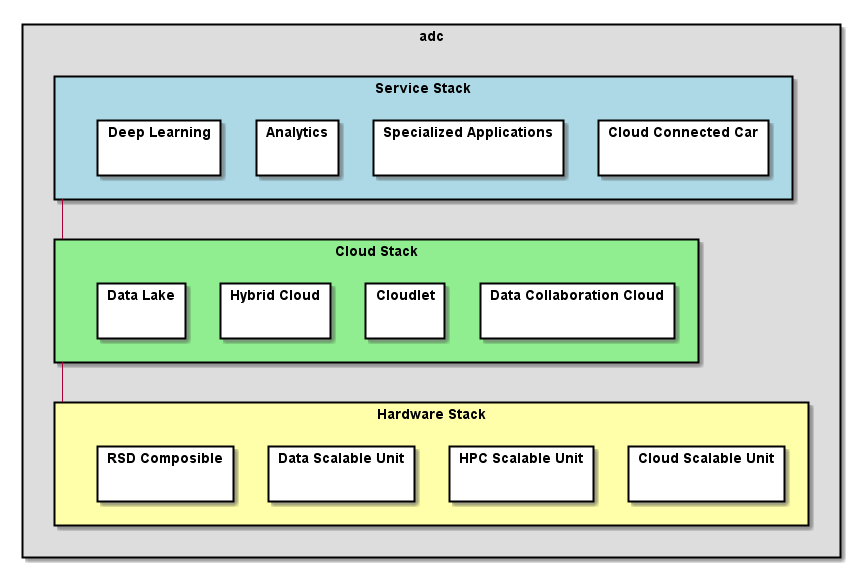
Service Stack
- Connected Car Cloud - (Ingestion, Annotation, Streaming, Data Storage)
- Specialized Applications (ADAS, Telematics, IVI, Dynamic Mapping)
- Analytics, AI Framework
- Connection Services to External Applications and data sources
Cloud Stack
- Cloudlet (Multi-cloud) connectivity
- Hybrid Cloud for connectivity between private and public Clouds.
- Software Define Infrastructure (Compute, Storage and Network)
- Data Lake (Hot, Warm and Cold Storage)
Hardware Stack
- Cloud Scalable Units (Scale Out General Cloud Racks)
- High Performance Scalable Units ( Specialized HPC hardware)
- Data Scalable Units (Scalable for Hot, Warm and Cold Storage)
- RSD Composible Architecture
Logical Architecture
The key input of data to Automotive Data Center is the Automobile. Data from the car is ingested into the data center through the ingestion engine. From there data is cleansed, analyzed, and multiple paths of data can be created depending on the applications being developed. Connection services allow for external systems to utilize the data both derived and raw.

Process Architecture
As data flows through the system different microservices modify or cleanse the data and then it is stored in the Raw Storage or in Primary and Secondary Data Stores depending on the applications being created for the Automotive Data Center.

Deployment model
The solution is deployed over multiple clouds in multiple data centers across the world. The Cloud Stack provides the federation of clouds so that vehicles can connect to the geographically nearest data center. As the car moves between geographies the data from that car will be held in the data center. Due to government regulations and changes in those regulations the infrastructure needs to be flexible to handle the movement of data and or the exchange of data if data soverienty is an issue.
In this architecture the ability to leverage public cloud for external application connective decouples the data center from external threat and connectivity. This decoupling gives another level of security for the data center.

Physical Architecture
The Service Stack sits on top of the federated cloud. This allows the cloud stack to determine the best location to run services. The Cloud stack federates multiple clouds together including public clouds for external application connective and development. The Private clouds in each data center are made up of common reusable stacks. These standard racks of machines come in multiple flavors of racks that can be tailored for specific services. Generally we would like all of the rack in the data center to be identical, but in reality that may not be the case.
